RACE: Rocket Arena Car Extreme
- 4.4
- Rating
- 50.00M
- Installs
- Free
- Price
 Analysis by App-foxy
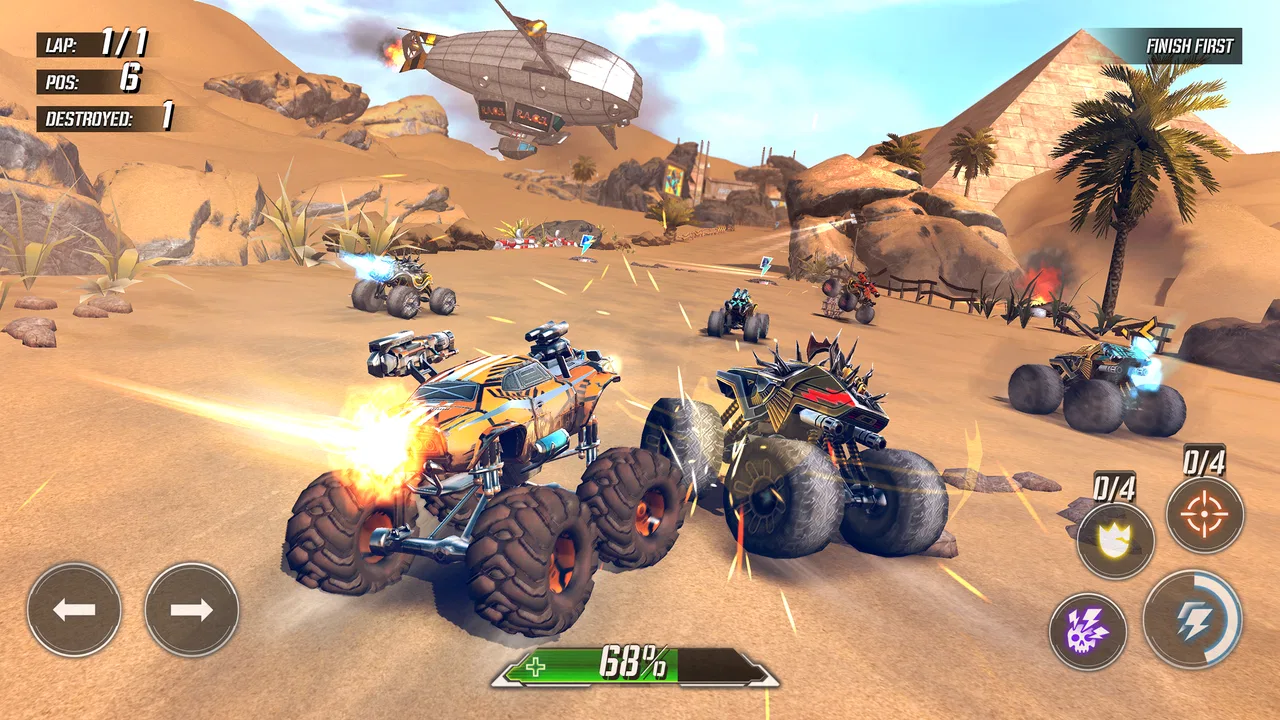
I went into RACE: Rocket Arena Car Extreme expecting a quick racing game, but its identity became clear within the first few minutes: this is a compact arena battle where driving and attacking are inseparable. You are not simply trying to trace the cleanest line around a circuit. You are steering through a 3D battlefield, looking for a chance to overtake, fire, survive incoming pressure, and finish strongly enough to keep your run moving.
That difference matters. If you want a calm driving simulator or a traditional racer focused on realistic handling, this will probably feel too aggressive. If you enjoy short bursts of arcade competition, where a good launch can turn into a messy fight and a single mistake can change the result, the game has a much stronger hook. I found myself starting another race not because every round was perfect, but because the action creates a clear question: can I make a better decision next time?
From the first launch to the first mistake
The opening action is easy to understand. Choose your car, enter a race, accelerate, and begin reading the arena. The controls are built around immediate reactions rather than a long learning period. You are watching the road, other vehicles, attack opportunities, and the space around you at the same time. That gives the first seconds a useful tension: even before you understand every detail, you know that positioning will matter.
You May Also Like

 Blood Strike: 2.5 Anniversary
Blood Strike’s Loadouts Turn Every Drop Into a Tactical Gamble
A close look at Blood Strike’s custom loadouts: how fast access to signature weapons reshapes its battle royale rhythm, rewards preparation, and narrows the gap between fights.

 Pandora - Music & Podcasts
Pandora’s Music Is Easy to Start, but Harder to Recover
Pandora’s strength is its low-effort path from a seed to a station. Its weak spot is how much confidence it asks you to place in connection, setup, and quiet recovery.

 8 Ball Pool
 Is Built on Rivalries, Rematches, and Routine
A close look at the rivalries, rematches, shared routines, and unanswered safety questions that turn a quick pool match into a persistent mobile community.

 Samsung Music
’s Quiet Strength Is Playing What You Already Own
Its reach comes less from spectacle than from dependable access to a personal library. That simplicity is both the app’s strongest retention engine and its ceiling.

 AccuWeather: Weather Radar
AccuWeather Review: A Quick, Clear Forecast for Everyday Decisions
For everyday plans, the best forecast is the one you can understand quickly. AccuWeather makes rain timing, radar, and local conditions easy to act on, with a few trade-offs.

 Hill Climb Racing
Why Hill Climb Racing Still Turns Crashes Into One More Run
A tiny car, a bumpy hill and one more upgrade: Hill Climb Racing keeps resurfacing because its simple chaos makes every near-miss feel personal.
More From Our News Desk



The racing category is only part of the experience. The battlefield design pushes you to think about traffic and confrontation, not just speed. A clean overtake is satisfying, but so is creating enough distance to avoid trouble or using an opening before another driver reaches it. The result feels closer to an arcade chase than to a conventional lap-based contest.
SMOKOKO LTD has kept the basic idea approachable. I did not need to study complicated driving theory before enjoying a round. The game communicates its purpose quickly through movement, impact, and the constant possibility of changing the order. That makes it suitable for someone who wants to play in short breaks rather than commit to a long session before the fun begins.
At the same time, simple controls do not mean shallow decisions. The best early habit is to stop treating acceleration as the only important input. I learned more by watching where opponents were likely to move than by trying to drive at maximum speed every second. In a crowded section, a slightly safer line can leave me in a better position for the next exchange.
Why the action feels different from ordinary arcade racing
The rocket-focused combat gives every encounter a second layer. In a normal arcade racer, contact may slow you down or send you into a barrier. Here, the threat feels more deliberate because attacks are part of the race rather than an accident. That changes how I approach a rival who is just ahead: I am not only asking whether I can pass, but whether passing now is worth exposing myself to a counterattack.
This is one of the game’s most useful strategic wrinkles. A player who concentrates only on the front of the pack can miss danger arriving from the side or behind. I found that glancing around the action and leaving a little room often helped more than forcing an immediate move. It is a small adjustment, but it turns random-looking chaos into something I can gradually read.
The trade-off is that the battlefield can feel noisy when several cars and attacks overlap. Players who prefer precise, predictable racing lines may find the interruptions frustrating. The game is at its best when you accept that control is temporary and adapt quickly. It is less satisfying if you want every outcome to reflect a perfectly measured corner.
The feedback rhythm: move, hit, recover, try again
The strongest part of the loop is its feedback rhythm. I make a move, see an immediate result, react to the new situation, and then decide whether to press forward or protect my position. A successful attack creates momentum, but it does not end the problem. The race keeps asking me to convert that advantage into something lasting.
That rhythm gives even a short session a beginning, middle, and finish. The beginning is about finding space and understanding the field. The middle becomes a series of quick judgments about attacks, overtakes, and survival. The finish is usually less about a single grand maneuver than about whether I avoided throwing away the advantage I had built.
The most important skill is not firing first; it is recognizing when an attack improves your position. Sometimes a shot opens a path, while another time it only creates a brief distraction and leaves me badly placed. I became more consistent when I stopped treating every available attack as an invitation. Saving an opportunity for a crowded section can be more useful than spending it immediately on the nearest car.
This is also where the game separates casual fun from repeatable play. A newcomer can enjoy the explosions and quick movement without analyzing much. After several rounds, however, the same player may start noticing patterns: when the pack compresses, when a rival is vulnerable, and when taking a wider route is safer than fighting for a narrow opening.
What the reward feels like during a race
The immediate reward is position. Moving past another car, surviving a dangerous exchange, or reaching the final stretch with a chance to win gives the race a clear emotional lift. I like that the reward is visible in the action itself rather than hidden behind a long explanation. You can feel when a decision worked because the field changes around you.
Winning the league is part of the game’s larger motivation, but the smaller rewards inside a race are what kept me engaged. A strong round is not only one where I finish first. It can also be a race where I recover after falling behind, avoid a bad fight, or turn a poor opening into a competitive finish. Those moments make progress feel personal instead of completely dependent on a perfect start.
There is a practical lesson here for new players: judge your improvement by the quality of your recoveries. If you only count victories, the rough rounds can feel wasted. If you notice that you are losing less time after a collision or choosing better moments to attack, the game becomes easier to appreciate. Its competitive satisfaction grows from making fewer costly decisions, not from discovering one magical tactic.
The free-to-play structure is worth considering before you settle in. The game costs nothing to start, while in-app purchases range from $0.99 to $41.99 per item. That makes it accessible for a quick trial, but players who dislike optional spending systems should decide early whether they are comfortable playing without buying anything. I would approach it as a free arcade racer first and treat purchases as a personal boundary, not as part of the basic reason to install it.
How the reset keeps another session tempting
A race ends quickly enough that failure does not feel final. When a round goes badly, I can usually identify the moment where the result began to slip: an overconfident attack, a poor line through traffic, or a decision to chase a rival when protecting my position would have been wiser. That makes the reset meaningful. I am not simply pressing replay out of habit; I usually have a specific correction in mind.
This is the game’s most effective session design. The reset is fast emotionally, even when the previous race was frustrating. A loss creates a small unfinished thought: what if I had waited, moved earlier, or avoided that exchange? Because the action is direct, the answer is available almost immediately in another attempt.
Still, the loop can become repetitive for players who need a large variety of racing formats. The central appeal is the same each time: drive, fight, protect your position, and chase the result. That consistency is a strength for short bursts, but it may feel limited beside a deeper racing game built around extensive car tuning, realistic tracks, or a long career structure.
My everyday use case is a short break when I have enough time for a few focused attempts but not enough time for a lengthy campaign. I can play while waiting for an appointment or during a commute break, then stop after a race without feeling that I have abandoned a complicated story. The same design is less suitable when I want a relaxing game that I can play half-attentively, because the arena demands frequent reactions.
Cars, competition, and the question of fairness
The car is more than a visual choice because it shapes how I think about each run, even when the main goal remains the same. I tend to prefer a setup that lets me stay involved in the fight rather than one that encourages reckless chasing. The useful approach is to learn what kind of situation makes my chosen car feel comfortable and then steer the race toward that situation.
That may sound obvious, but it prevents a common mistake: changing cars every time a race goes badly. Sometimes the problem is not the vehicle. It is an aggressive opening, poor awareness of the surrounding pack, or an unwillingness to reset after losing momentum. I found it more helpful to keep a familiar choice long enough to understand my own mistakes before blaming the car.
The competitive side also benefits from restraint. When I am near the front, the temptation is to keep attacking simply because an opportunity appears. Yet a safe line and a clean finish can be more valuable than a risky move that leaves me exposed. When I am behind, the opposite is true: waiting too long can make recovery impossible. The game works best when I balance those two pressures instead of using one strategy for every race.
Players asking whether it is suitable for younger users should note its Everyone 10+ content rating. The presentation is colorful and action-oriented, with rockets and vehicle combat at its center. I would describe it as accessible arcade action rather than a realistic driving simulation, but parents should still consider whether that style of competitive combat fits the player they have in mind.
Where it stands beside other racing choices
Compared with a realistic racing simulator, this game is faster to understand and less concerned with authentic vehicle behavior. You are not installing it to practice braking points, learn real-world circuits, or admire a detailed simulation of motorsport. Its appeal is the immediate combination of driving and attack, with a result that can change in seconds.
Compared with a standard kart racer, the arena focus makes the competition feel more confrontational. The road is not merely a route to the finish; it is a space to control, escape, and contest. That gives the game a sharper edge, although it also means that a player seeking gentle, family-friendly racing may prefer a less combative alternative.
Compared with a long-form car collection game, the advantage here is commitment. I can start playing without first spending a long time managing a garage or learning a large set of systems. The disadvantage is depth for players who enjoy detailed customization and a broad career. If your favorite part of racing games is tuning every component, this is probably not the right destination.
The game has also reached a substantial audience, with over 50 million installs and an average rating of 4.4 from around 203 thousand ratings. Those figures do not replace personal taste, but they match my impression that the core loop is easy to pick up and broadly appealing. The presence of around 1.4 thousand written reviews suggests that many players have found enough to discuss beyond the basic act of driving.
Practical details before you decide
RACE: Rocket Arena Car Extreme was released on November 30, 2021, and the current version is 1.4.23. It supports devices running Android 6.0 or later. For a player using an older phone, the operating-system requirement is the first simple check to make before expecting a smooth experience. I would also leave enough free attention for the action itself rather than assuming this is a passive time-killer.
The game is free, which makes trying it straightforward. My advice is to play several sessions before deciding whether its progression and competitive rhythm suit you. The first impression is exciting because of the rockets and collisions, but the longer-term question is whether you enjoy repeating the decision cycle: find an opening, take a risk, recover from trouble, and make the next attempt smarter.
One useful workflow is to use short personal goals instead of chasing a win every time. In one session, focus on holding a safe line. In another, practice waiting for a better attack window. This makes the game more rewarding when the results are mixed and helps reveal whether your frustration comes from the controls, the combat, or simply taking risks that do not match your style.
I would skip it if you want a quiet racer, a realistic simulator, or a game where every loss can be traced to exact technical execution. I would also be cautious if optional purchases make free-to-play games uncomfortable for you. On the other hand, players who enjoy quick PvP-style pressure, colorful vehicle action, and races that can turn around suddenly will find a clear reason to return.
My verdict on the complete loop
What works for me is the complete chain: the first launch gives me an immediate objective, each attack or escape produces readable feedback, a strong position feels rewarding, and a loss resets the challenge before the frustration has time to settle. The next session begins because I usually know what I want to change. That is a better reason to replay than a vague promise of more content.
The limitations are just as clear. The action can become hectic, the repeated structure will not satisfy everyone, and the free-to-play purchase range means some players will want to set firm spending limits. It is also not trying to replace a serious racing simulator. Its value comes from being an accessible battle racer, not from offering the most realistic driving model or the deepest garage management.
After spending time with it, I see RACE: Rocket Arena Car Extreme as a good recommendation for a friend who wants racing with immediate danger and quick restarts. I would tell that friend to play with awareness rather than simply holding the accelerator, save attacks for moments that change the race, and treat recovery as part of the skill. If you enjoy action that gives you a reason to try again immediately, this is a free racing game worth testing.
FAQs for RACE: Rocket Arena Car Extreme
01What is the main objective of RACE: Rocket Arena Car Extreme?
RACE: Rocket Arena Car Extreme is a high-octane racing game that focuses on intense car battles in a vibrant arena setting. Players aim to outmaneuver opponents using a combination of speed, strategic upgrades, and powerful weapons. The goal is to finish first while causing maximum destruction, making every race thrilling and unpredictable.
02Can I play RACE: Rocket Arena Car Extreme offline?
Yes, RACE: Rocket Arena Car Extreme offers an offline mode, allowing players to enjoy the game without an internet connection. This is ideal for practicing your skills or playing in environments where connectivity is limited. However, certain features and multiplayer modes require an internet connection for full functionality.
03What customization options are available for vehicles?
In RACE: Rocket Arena Car Extreme, players can customize their vehicles extensively. Options include upgrading engines, armor, and weapons to improve performance on the track. Visual customization is also available, allowing players to personalize their cars with a variety of skins and decals to make their vehicle stand out in the arena.
04Are there in-app purchases in RACE: Rocket Arena Car Extreme?
Yes, the game includes in-app purchases that allow players to buy in-game currency or special items. These purchases can enhance gameplay by unlocking new vehicles, upgrades, or cosmetic items faster. However, all content is accessible through gameplay, ensuring a balanced experience for those who prefer not to spend extra money.
05What are the system requirements for RACE: Rocket Arena Car Extreme?
For Android devices, RACE: Rocket Arena Car Extreme requires at least Android 5.0 and a reasonable amount of free storage space. For iOS, it requires iOS 10.0 or later. The game is optimized for both platforms, but newer devices will provide smoother performance and better graphics quality, enhancing the overall gaming experience.
Pros
- Stunning graphics with vibrant visuals.
- Diverse tracks for endless racing fun.
- Smooth controls enhancing gameplay experience.
- Variety of cars with customizable options.
- Regular updates with new content.
Cons
- In-app purchases can be expensive.
- Requires a stable internet connection.
- Limited offline gameplay options.
- Some ads can be intrusive.
- High battery consumption during play.

RACE: Rocket Arena Car Extreme
Gallery